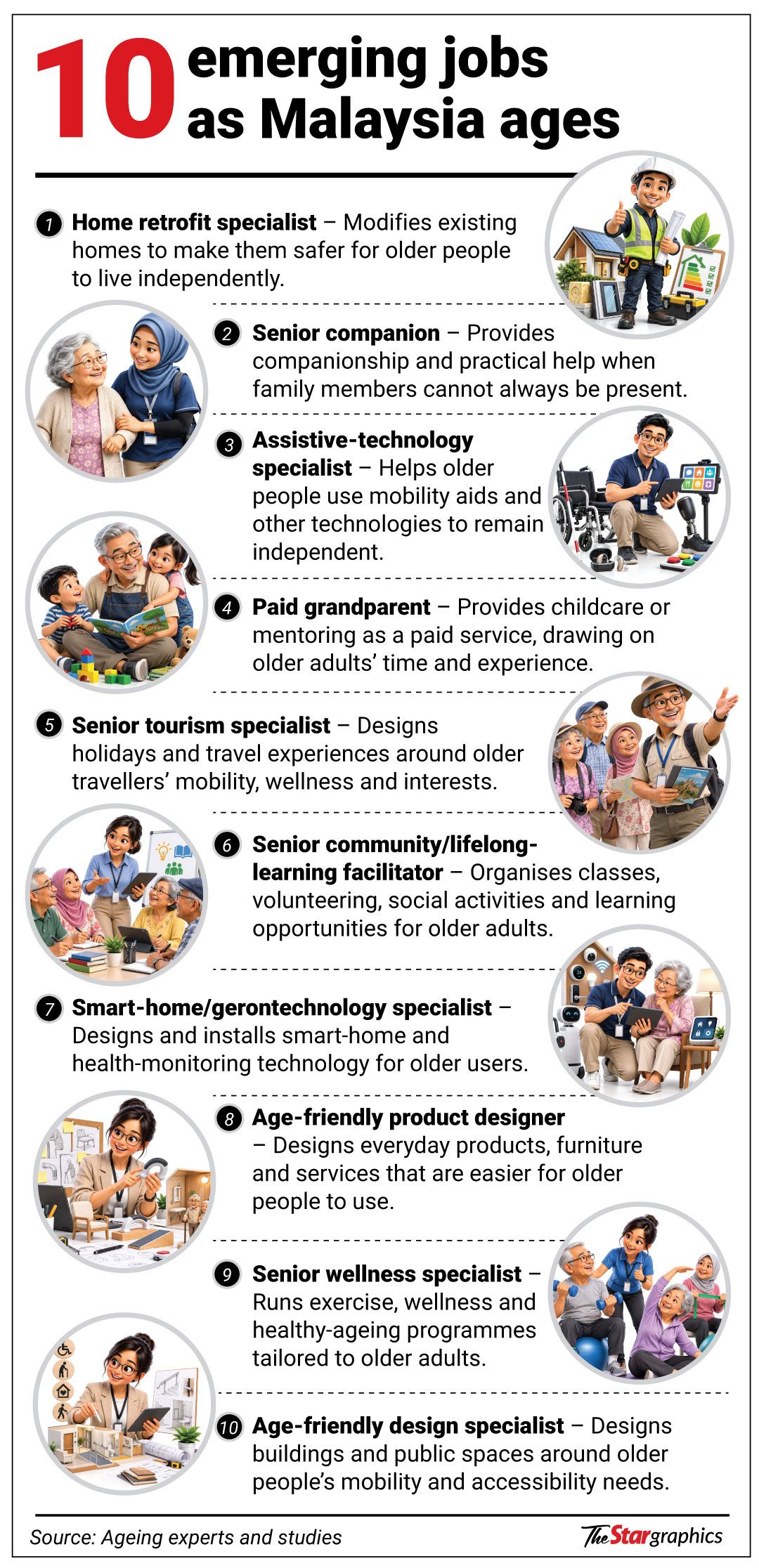
PETALING JAYA: From specialists who redesign houses for ageing residents to activity managers who organise social and recreational programmes for seniors, a new class of jobs is emerging as Malaysia's population grows older.
As more people choose to age in their own homes and communities, demand is expected to grow for services that support their independence and social engagement, say experts.
According to the Department of Statistics Malaysia, the population aged 65 and above grew 26%, or by 586,100 people, from 2.29 million in 2021 to an estimated 2.88 million this year.
This is more than three times the 7.2% growth among the working-age population, aged 15 to 64, over the same period.
People aged 65 and above are estimated to make up 8.4% of Malaysia’s population this year.
Demographics expert Chai Sen Tyng said Malaysia will need more than just doctors, nurses, allied health professionals and care workers to support its ageing population.
Social workers and activity managers are also more in demand, he said, amid the rise of home- and community-based care and social services.
Despite widespread concern about AI displacing jobs, Chai said demand for hands-on roles done by humans, such as home retrofit specialists and domestic repair workers, is expected to rise.
Older homeowners, he said, will increasingly need good handymen and age-proofing for their homes.
Chai, a senior research officer at the Malaysian Research Institute on Ageing, said further development of long-term care insurance, financing and pension reforms could also create jobs within the broader longevity economy.
Specialised wealth and retirement advisers are already becoming more prominent within the financial planning landscape, he said.
“There will be significant shifts in demand. Institutional care was never popular, but we will see more ageing-in-place solutions,” he said.
He added that services related to later-life and end-of-life planning, including evolving funeral services, are also growing.
Other roles, such as elder law practitioners, fall outside the health sector.
“Medical devices and assistive technology services, such as electric wheelchairs and stairlifts, are already here in Malaysia.
“PERKESO (Social Security Organisation) is on its third hi-tech cybernetic rehabilitation centre, which houses exoskeleton technology such as Cyberdyne’s HAL (Hybrid Assistive Limb).”
Universiti Kebangsaan Malaysia’s Critical Media Studies associate professor Dr Jamaluddin Aziz said Malaysia’s ageing population would require closer collaboration between older and younger generations in the workforce.
“The old model of education, followed by work and then retirement will be dismantled, giving way to a more flexible, dynamic and multi-stage job culture.
“As Gen X workers continue working into later life through part-time, advisory and consultancy roles, Gen Z could contribute through the gig economy, technology-enabled solutions and innovative services for older people,” he said.
He said the changing labour market was also likely to spur more entrepreneurship among older people.
“New employment opportunities are expected to emerge around the silver and growing care economy, including technology, social entrepreneurship, smart-city design and technical jobs,” he said.