Is there still a place for the turtleneck in the modern man’s wardrobe?
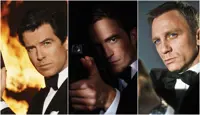
Perhaps it is time to have a James Bond moment, especially now that the identity of the next 007 has finally been revealed.
Almost every Bond has been a turtleneck wearer at some point in the franchise, which speaks to the perennial appeal of this particular item of clothing, albeit but one of its many dimensions.
It’s rare, after all, to find a garment that can symbolise both the ultimate suave, martini-swilling spy and Steve Jobs, the Silicon Valley guru who brought design to computing.
But such is the turtleneck. Or, to call it by one of its historic names, the polo neck.
Since its creation in the 15th century, when knights adopted neck padding to prevent chain-mail chafing, the turtleneck has been associated with artists, the counterculture, fishermen and la dolce vita (also, yes, polo players).
It was worn as a trademark by the Beats, the Black Panthers, Steve McQueen and the Rock.
Read more: Robert Pattinson as James Bond: Which luxury brands will style the new 007?
And though it briefly fell out of favour in the 1980s, it has been making its way back into men’s wardrobes ever since.
Recently it has been adopted by politicians as disparate as Emmanuel Macron, the president of France, who modelled his turtleneck in 2022 as a symbol of his drive to reduce energy consumption (lower the office temperature! wear a turtleneck!) and New York City mayor Zohran Mamdani.
Matt Damon just wore a Ralph Lauren version to the Council Of Fashion Designers Of America (CFDA) gala.
It is, said Bailey Moon, a stylist who works with men like actor Morgan Spector, the perfect garment in the post-tie world of the post-pandemic era, because it is “a great alternative to a shirt and tie under a blazer or with a great coat and jeans”.
“It makes an outfit feel polished without being overdressed,” Moon said.
A turtleneck “denotes capability, strength and unfettered minimalism”, said costume designer Arianne Phillips, who has used turtlenecks in numerous films to reflect character.
“It does not discriminate and is always in fashion.”
Which is not to say it doesn’t have its pitfalls. Precisely because of its rich history, a turtleneck also denotes a time period, which is useful in film but less desirable in real life.
When Phillips was working on a film set in the 1960s, she included a number of mock turtlenecks to designate the period.
“I also used turtlenecks on Pedro Pascal and Taron Egerton for Kingsman: The Golden Circle for their 1970s-inspired skiwear,” she said (for another reference, see Robert Redford in the 1969 film Downhill Racer).
It is precisely because of these associations that my colleague Jacob Gallagher, our men’s fashion reporter, said he had started to avoid turtlenecks.
“I think the postmortem meme-ing of Steve Jobs really hurt their reputation,” Jacob said.
“When you wear one now, you look like you’re trying to do a Jobs. Especially a black one. Or at least you can appear like you’re trying something.”
Read more: Too tall, too short, too fashionable: Why menswear still doesn't fit all guys
He has largely swapped his turtlenecks for V-neck sweaters, though he did acknowledge, “Maybe if I was hiking around upstate, I’d go in for a chunky turtleneck, really get that rugged man costume out.”
To avoid looking stuck in the past, the gauge and style of the turtleneck play an important role.
“It comes down to fit and how you wear it,” Moon said.
Opt for “a fine-gauge merino wool or cashmere turtleneck in a neutral colour”, he said. Think of it almost as the cool weather version of a T-shirt – and always consider the neck.
“You want something that sits naturally rather than feeling like it’s strangling you,” Moon said. – ©2026 The New York Times Company
This article originally appeared in The New York Times.